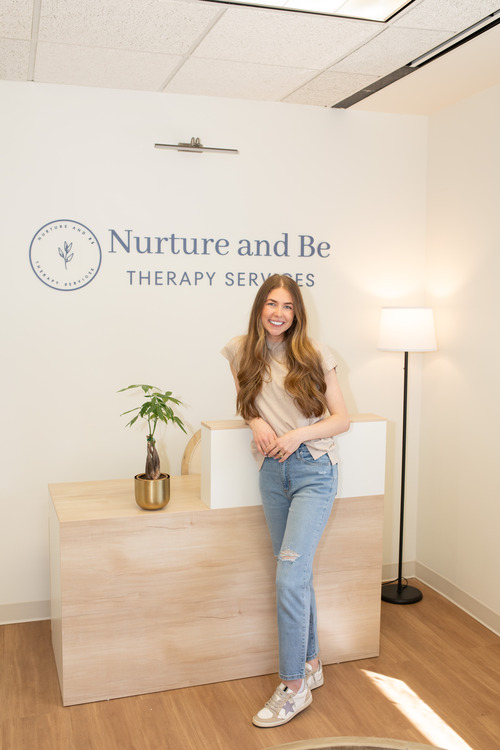
From the Nurture & Be Therapy Services team in Peachtree City, Georgia, with insights from our founder, Brooke Ferreira, LMFT
Quick answer: You don't need a crisis, a diagnosis or the right words to start therapy. At Nurture & Be, you begin with a free consultation, get matched with a provider licensed in your state, and set goals with your therapist in your first few sessions. We see clients in person in Peachtree City, Georgia, and virtually across Georgia and Florida.
A lot of women wait to start therapy until they can explain exactly what's wrong, or until things get bad enough to justify it, or until they've tried everything else first.
Many people come to therapy in the middle of something. Life is mostly good and something still feels hard. You're handling it, and you're tired of handling it alone.
On the Nurture & Be Podcast, our founder Brooke Ferreira, LMFT, recorded a solo episode about the lessons she was still learning in real time. She closed with this: "Healing happens in real life and not everything is figured out, but everything is figure outable eventually."
You can start therapy from exactly that place.
Do I need to know what's wrong before I start therapy?
No. You don't need a diagnosis, a crisis or a tidy explanation. You might only know that you feel stretched thin, that you keep reacting in ways you don't like, or that something you used to manage now feels heavier.
Brooke described a version of this on the episode. When things got hard, she noticed an urge to prove she could handle it: "I need to show that I can navigate this well." What she wanted was permission "to also just say, like, this is really hard."
Therapy gives you a place to say that out loud.
What happens when I reach out to Nurture & Be?
You start with a free consultation with our team. We'll ask what's going on and what you'd like help with. Then we'll match you with a provider whose experience fits what you're looking for and who's licensed to see you in your state.
You don't need the right words for that call. Part of our job is helping you find them.
What do the first few sessions look like?
Your first sessions are part of the work. Your therapist will get to know you: what's happening now, what has shaped you, and what you want to feel different.
Around your third session, you and your therapist set goals together, and you get a copy of them, so you both know what you're working toward.
How does Nurture & Be approach therapy?
We use a shared framework called the Five Phases: Awareness, Understanding, Compassion, Repatterning and Integration. It gives the work a structure without putting it on a schedule. Everyone moves through it differently, and your therapist uses their own clinical judgment within it.
In everyday terms, you'll work on noticing a pattern, understanding where it came from, meeting it with compassion instead of shame, practicing a different response, and making that response feel like yours.
Along the way, we build in moments to look at progress together, including an assessment you review with your therapist around session 8 and an informal goal check around session 12. These check-ins help you see what's changing and decide what to focus on next.
What if my progress feels slow?
Some stretches of change move quickly, and others feel slow or heavy. Brooke spoke about this too: "When things feel shaky, that doesn't always mean that something is wrong. It just means that something new is being built."
A slower stretch in therapy doesn't mean you're doing it wrong. Bring it into the room and talk it through with your therapist. Keeping your regular sessions through those weeks gives the work room to build.
Is therapy at Nurture & Be in person or virtual?
Both. We see clients in person at our office in Peachtree City, Georgia, which is a short drive from Fayetteville, Tyrone and Newnan. We also offer virtual sessions for clients in Georgia and Florida, depending on each provider's licensure, and medication management for clients in Georgia.
FAQ
What should I say in my first therapy consultation?
Start with what's been feeling hard and what you'd like to be different. You don't need a diagnosis or a full story, and our team will ask questions to guide the call.
How do I find a therapist for moms in Peachtree City, GA?
Look for a practice that works with moms and families and offers a consultation to check fit. Nurture & Be sees clients in person in Peachtree City and virtually in Georgia and Florida.
Can I do therapy online in Florida?
Yes. Nurture & Be offers virtual therapy in Florida with providers licensed there.
Do I need a crisis to start therapy?
No. Many people start therapy because something feels heavier than it should, even when life is mostly going well.
What is the Five Phases model?
It's the shared framework Nurture & Be therapists use: Awareness, Understanding, Compassion, Repatterning and Integration. It gives therapy a structure while leaving room for each person's pace.
When you're ready to start, book a free 20-minute consult with our team. We'll help you match with the right therapist.
This post is educational and is not a substitute for therapy or medical care. If you're in crisis, call or text 988 (Suicide & Crisis Lifeline) or call 911.